
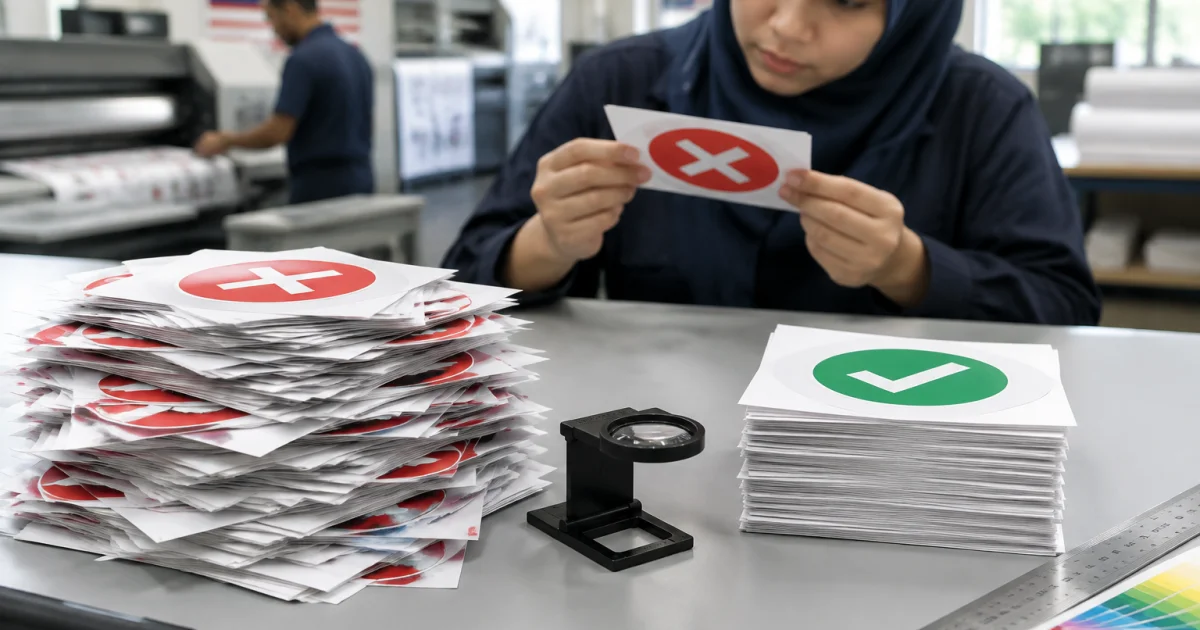

“Cheapest” sounds safe when you’re buying something that looks simple: a roll of stickers, a barcode label, a logo label for bottles, or a few thousand product labels for a launch. But in real operations, labels don’t live on a spreadsheet—they live on hot-fill lines, in chillers, under handling, in delivery vans, and on shelves where customers will touch them.
This is why label sticker printing malaysia buyers often discover a frustrating truth: the cheapest quote can become the most expensive order once reprints, downtime, relabelling labour, and disposal enter the picture.
This article is an opinionated, practical cost-of-reprint perspective for brand owners and purchasing teams. The aim isn’t to shame budget suppliers or claim one “perfect” choice exists. It’s to give you a way to evaluate total cost—so you can choose where to save money without accidentally paying twice.
The hidden math: unit price vs total applied cost
When people compare label quotes, they usually compare:
- Price per piece / per roll
- Minimum order quantity
- Lead time
Those matter, but they’re not the full cost. A more useful comparison is the cost of applied labels that survive real use. That number includes what happens after the labels arrive: application, performance, and whether you can ship the product confidently.
In practice, the “cheap” option becomes expensive when it triggers any of these outcomes:
- Reprint: you pay again for corrected labels (and often rush freight).
- Relabelling: staff time to strip and re-apply, plus rejected packaging.
- Production disruption: line stops, slowdowns, or manual workarounds.
- Returns and complaints: labels that peel, fade, or scan poorly can cause retailer issues.
- Missed deadlines: launch dates and delivery schedules slip.
None of these costs show up in the per-piece quote, but they dominate the total cost when something goes wrong.
What causes reprints most often (and why “cheap” is vulnerable)
Reprints are rarely caused by one single mistake. They’re usually caused by a chain of small compromises—often made unintentionally. Below are common triggers that increase the odds you’ll need to reorder.
1) Wrong material choice for the real environment
Material is one of the biggest drivers of label performance. If the quote is low because the material is basic or mismatched to your use case, failure can be predictable.
Examples:
- Chilled / frozen items: condensation can weaken adhesion; some facestocks wrinkle when applied cold.
- Oily surfaces (certain food jars, cosmetics containers): standard adhesive may lift at the edges.
- Outdoor or industrial exposure: sunlight, heat, chemicals, and abrasion can fade ink or damage facestock.
If you’re choosing between paper labels and synthetic options such as PP labels (polypropylene) or other durable materials, the cheapest option might be paper—until moisture, tearing, or scuffing enters the equation. Paying slightly more for the right substrate can be cheaper than paying twice for reprints and relabelling.
2) Adhesive mismatch (the part you can’t easily “see”)
Even when two labels look identical, adhesive type can be very different. Permanent, removable, freezer-grade, high-tack, and specialty adhesives exist because surfaces and conditions vary widely.
Low-cost quotations sometimes assume a default adhesive. That’s fine for some products, but risky when your packaging is:
- Textured or low-surface-energy plastic
- Powder-coated, curved, or small-diameter bottles
- Exposed to heat (warehouse, logistics) or cold (chillers)
The painful part: the label might apply “okay” on day one, then start lifting a week later—after you’ve shipped. If that triggers returns or retailer penalties, the “cheap” quote becomes the most expensive.
3) Print quality that doesn’t support scanning and compliance
If your label includes barcodes, QR codes, serials, or small ingredient text, clarity matters. One of the most common reprint scenarios is: labels look fine to the naked eye, but scanning is inconsistent.
Causes include:
- Low resolution or dot gain that thickens barcode bars
- Poor contrast (dark background, glossy glare, or incorrect ink density)
- Inconsistent printing across the roll leading to random scan failures
For operations that also run in-house variable data, pairing the right label stock and ribbon with your barcode printer matters too. The cheapest label material can smear, scratch, or scan poorly depending on your printing method and handling.
4) Weak proofing process (or “approve fast, fix later” culture)
In my view, the fastest path to reprints is rushing approvals. When timelines are tight, teams skip details: dielines, bleed, text legibility, barcode quiet zones, and version control.
Common mistakes that trigger costly reprints:
- Wrong nutrition panel or ingredient list version
- Spelling errors in key claims or usage directions
- Incorrect size or die-cut shape that doesn’t fit the container
- Colour shifts that make a premium brand look “off” on shelf
A cheaper supplier may not include robust prepress checks or may assume you’ll catch everything. That’s not “bad faith”—it’s often how low prices are achieved: less time spent on checking. The risk is simply pushed to you.
A practical cost-of-reprint checklist before you accept a “cheap” quote
If you want to keep costs low and avoid reprints, use a checklist that forces clarity. Here are questions purchasing teams can ask to stress-test a quote without turning it into a long technical debate.
Confirm the application reality
- What is the container material (glass, PET, PP, HDPE, metal)?
- Is it applied hot, warm, room temp, or cold?
- Will it face water, oil, friction, freezer, or sunlight?
- Is the surface curved, textured, or small (edge-lift risk)?
If the supplier can’t recommend a material/adhesive combination based on these facts, you’re mostly guessing.
Specify performance requirements (simple, not vague)
- “Must remain adhered in chiller conditions without edge lifting.”
- “Barcode must scan reliably at retail checkout.”
- “Ink must resist smudging from handling.”
- “Label must not tear during application.”
These statements help prevent the “we printed what you asked for” scenario, where the job meets the quote but fails the real use case.
Ask what’s included in the price
- Is prepress file checking included?
- Is colour matching / consistency discussed (especially for reorders)?
- Are there setup charges hidden outside the unit price?
- What happens if there is a print defect (replacement policy, timeline)?
The cheapest unit price can be attached to the least support—again, not necessarily “wrong”, but it changes your risk profile.
Frequently Asked Questions
How do I compare label quotes beyond price per piece?
Compare the total cost of applied labels: material + adhesive suitability, print consistency (especially barcodes), expected wastage, and the likelihood of reprints or relabelling. Ask what’s included (prepress checks, colour consistency guidance, replacement timeline for defects) and confirm the real application conditions (cold, oil, moisture, abrasion).
Are PP labels better than paper labels for product packaging?
Often, yes—if your product faces moisture, condensation, handling abrasion, or needs better tear resistance. PP labels typically handle water and scuffing better than standard paper. However, paper can be suitable for dry, indoor conditions and may be more cost-effective when durability demands are low. The best choice depends on your container material, storage, and distribution conditions.
Why do barcodes fail to scan on some printed labels?
Scan failures can happen due to low contrast, excessive gloss glare, ink spread (dot gain), inconsistent print density across the roll, or a barcode size/layout that doesn’t meet practical scanning needs. If you print variable data in-house, mismatched label stock and ribbon (or incorrect printer settings) can also cause smudging and poor readability.
Should I request a sample before mass label printing?
If the label is new (new bottle, new finish, new storage condition), a small sample or pilot run is usually worth it. Testing adhesion, edge lift, smudge resistance, and scan reliability on your actual container can prevent a full reprint later—especially for chilled, oily, or high-handling products.
Can one supplier handle labels and custom boxes together in Malaysia?
Yes. Some printing partners offer one-stop solutions covering labels/stickers and custom packaging boxes. Coordinating both can reduce redesign loops, improve shelf consistency (colours/finishes), and simplify procurement—especially if you need both product labels and retail-ready packaging.
Reduce reprint risk with the right label material and print checks
If you’re comparing “cheap” quotes and want to avoid paying twice, Altrapac can help you evaluate material, adhesive, finishing, and barcode/print requirements based on how your labels are actually used.
As a one-stop printing and packaging partner (labels, stickers, boxes, food packaging, paper bags, and barcode-related solutions) with over 30 years of experience, we support both SMEs and high-volume operations from our Penang base.
Share your container type, storage conditions, and quantity range—then we’ll recommend options that balance cost with reliability.