


In retail environments, packaging is often the first thing customers notice. Before they compare prices or read product details, they judge based on visual appearance. This means packaging plays a direct role in shaping perception, trust, and purchase decisions. A strong product can still be ignored if its packaging fails to communicate value quickly and clearly.
Many brands invest in packaging design but still make avoidable mistakes that reduce shelf visibility and weaken brand impact. Understanding these mistakes is important for building packaging that supports sales instead of holding the product back.
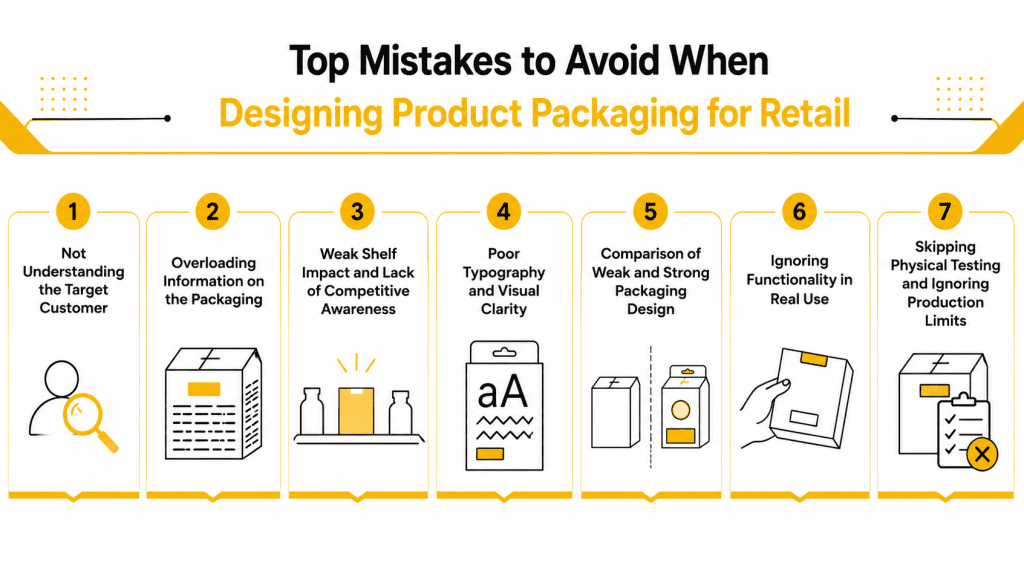
1. Not Understanding the Target Customer
One of the most common packaging mistakes is designing without a clear understanding of the target customer. Packaging is not just visual decoration; it is a form of communication. If the design does not align with customer expectations, the product will feel out of place even if the quality is good.
Different audiences respond to different visual styles, and ignoring this leads to poor market connection. For example, design preferences can vary significantly depending on the customer group:
- Premium customers prefer clean layouts, soft color palettes, and minimal design that signals quality
- Younger audiences respond better to bold colors, strong contrast, and expressive typography
- Practical buyers prioritize clarity and easy-to-read product information
When packaging does not reflect the intended audience correctly, it fails to create emotional connection and ultimately reduces purchase interest and overall product appeal.
2. Overloading Information on the Packaging
Another frequent mistake is placing too much information on the packaging. Many brands try to include everything such as product benefits, ingredients, certifications, promotions, and instructions in one space. While the intention is to inform, the result often becomes visual clutter.
Retail customers usually make decisions within a few seconds. If they cannot quickly identify the product and its purpose, they will move on to another option.
Good packaging should focus on clarity. The most important message must be immediately visible, while supporting information should be secondary.
3. Weak Shelf Impact and Lack of Competitive Awareness
Packaging does not exist alone in retail. It always competes with similar products on the shelf. A design that looks good in isolation may still fail when placed next to competitors.
Many brands ignore this reality during the design stage. If packaging uses similar colors, similar layout structure, or lacks contrast, it blends into the background and loses attention.
Effective packaging design must consider real shelf conditions. It should be noticeable at a distance, easy to recognize quickly, and clearly different from competing products in the same category.
4. Poor Typography and Visual Clarity
Typography is one of the most important elements in packaging design because it controls readability. If customers cannot read the product name or key message instantly, the packaging fails its purpose.
Common typography mistakes include overly decorative fonts, inconsistent font usage, and small text size that is difficult to read from a distance.
Good packaging typography should ensure:
- Clear and readable product name
- Strong visual hierarchy between brand and details
- Simple font styles that work in real retail environments
Comparison of Weak and Strong Packaging Design
| Aspect | Weak Packaging Design | Strong Packaging Design |
| Target Customer | Generic design with no focus | Designed based on customer profile |
| Information Layout | Overcrowded and unclear | Structured and easy to scan |
| Shelf Visibility | Blends with competitors | Strong contrast and recognition |
| Typography | Hard to read or overly decorative | Clean and readable |
| Material Quality | Low durability and weak finish | Durable and product suitable |
| Brand Identity | Inconsistent across platforms | Consistent and unified |
5. Ignoring Functionality in Real Use
One of the key packaging mistakes is focusing only on appearance while ignoring how the packaging performs in real-world use. Packaging must work well in transportation, storage, handling, and customer experience. If it fails in any of these areas, it negatively impacts overall satisfaction.
Common functional issues include:
- Weak structural design that cannot withstand handling or shipping
- Poor product protection leading to damage during transport
- Difficult or inconvenient opening experience for customers
A successful packaging design always balances visual appeal with practical performance, ensuring it looks good and functions effectively in real use.
6. Skipping Physical Testing and Ignoring Production Limits
Many brands rely only on digital mockups when finalizing packaging design. While digital visuals are helpful, they do not fully represent real production output. Differences in color, material behavior, and structure often appear only after physical samples are made.
Without testing, brands risk costly mistakes during mass production. These mistakes can include incorrect sizing, poor print quality, or structural failure.
Another issue is ignoring production limitations. Not all packaging designs can be produced by every supplier. Some require special printing methods or specific materials. If this is not considered early, it can lead to redesign work, higher cost, or production delays.
Conclusion
Packaging is more than just a container. It is a key communication tool that influences how customers perceive a product in retail environments. It affects visibility, trust, and purchasing decisions within seconds.
Avoiding these common mistakes helps ensure packaging works as a strategic marketing asset instead of just a physical box. Strong packaging improves shelf performance, strengthens brand identity, and increases customer confidence.
Upgrade your packaging with Altrapac custom box printing in Malaysia, delivering reliable quality, strong materials, and precise printing to help your products stand out on retail shelves.
Frequently Asked Questions (FAQs)
Why is packaging design important for retail products?
Packaging is important because it is the first thing customers notice. It influences buying decisions, communicates brand value, and helps products stand out on crowded retail shelves.
What is the most common mistake in packaging design?
The most common mistake is overloading packaging with too much information. This reduces clarity, weakens visual impact, and makes it harder for customers to quickly understand the product.
How does packaging affect customer buying decisions?
Customers often make quick decisions based on appearance. Good packaging improves trust, attracts attention, and makes the product feel more valuable, which increases the chance of purchase.
Why is shelf impact important in packaging?
Shelf impact determines how easily a product stands out among competitors. Strong visual contrast, clear typography, and structured design help attract attention in a few seconds.
How can professional packaging improve sales?
Professional packaging improves visibility, communicates brand value clearly, and builds trust. This increases the chance of attracting customers and improving conversion in retail environments.