
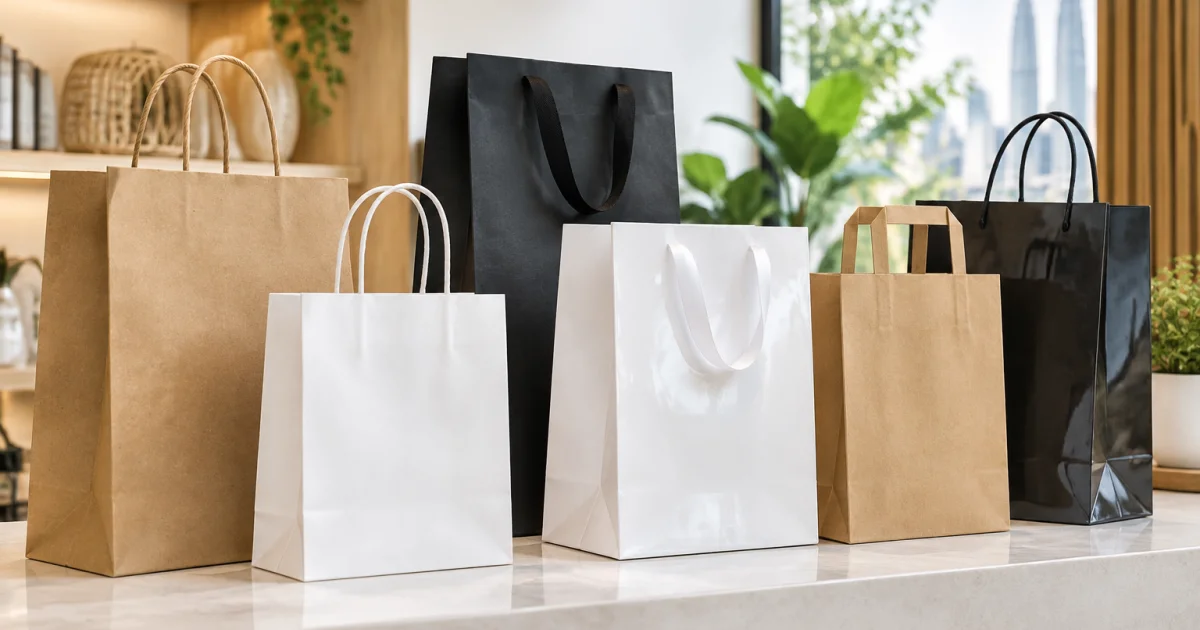

Across Malaysia, more retailers and F&B operators are treating paper bags as a “standard” carrier option rather than a premium add-on. Whether the driver is branding, customer perception, or operational consistency, the practical result is the same: more teams are ordering paper bags more frequently, in more variants, and with tighter turnaround expectations.
That change sounds simple until you start comparing quotes. Suddenly, the details matter: matte vs gloss lamination, spot UV vs no coating, twisted paper handles vs flat handles, reinforced patches, gusset sizing, and whether your artwork needs a new dieline. Small spec choices can ripple into cost, durability, and—most importantly—lead time.
This article breaks down what the shift to paper bags means in real purchasing terms: which print finishes suit different retail use cases, how handle types change strength and production steps, and how to plan your order so you don’t get stuck reworking specs last-minute. If you’re also juggling boxes, labels, or stickers for the same product launch, we’ll connect the dots so your packaging system stays consistent across channels.
Why the paper bag shift changes buying criteria (not just materials)
When paper bags were ordered occasionally—typically for events, festive seasons, or premium purchases—buyers often prioritised “looks” and accepted longer lead times. As paper bags become a routine operational item, the buying criteria usually shift toward repeatability and supply stability.
In practice, that means you need to treat paper bags like any other packaging component:
- Standardise a small set of specs (sizes, handle type, finish) that you can reorder without redesign.
- Align with your product packaging so the bag doesn’t look disconnected from the box, label, or sticker style.
- Plan for replenishment cycles, not just a single campaign order.
- Reduce last-minute decision points that extend proofing and production scheduling.
Many buyers underestimate how many “micro-decisions” sit inside the phrase paper bag printing malaysia. The shift in demand makes those micro-decisions more visible—because you feel them through longer timelines, spec clarifications, and mismatched expectations between marketing and operations.
Understanding paper bag construction: what your supplier needs to quote accurately
A quotation that looks “high” or “slow” is often the result of missing construction details. Before you ask for prices, make sure you can answer the questions below (even roughly). It speeds up quoting and reduces change orders later.
1) Bag size and orientation
Paper bags are typically defined by width (W) × gusset (G) × height (H). A small change in gusset can impact board utilisation, die cutting, and how well the bag stands. For takeaway and bakery use, gusset and base structure often matter more than height.
2) Paper type and feel
Kraft is common for a natural look and good scuff tolerance; white art paper gives brighter colour reproduction. Beyond “kraft vs white,” buyers should ask for guidance on thickness (gsm) appropriate to load and usage patterns.
3) Handle style and reinforcement
Handles are not just a style decision—they change how the bag is assembled. Some handle options require extra steps such as patch reinforcement at the handle attachment point.
4) Printing method, colour coverage, and finishing
Large solid areas, heavy ink coverage, or special finishes may need additional drying/curing time or more careful handling to avoid marking.
When you provide these basics upfront, you’ll get quotes you can actually compare—because each supplier is pricing the same build.
Print finishes: how to choose for durability, brand look, and speed
With the growing shift to paper bags, print finish decisions are no longer just about “making it nicer.” They’re about matching your operational realities: will bags be stored in a humid back room, handled with wet hands in an F&B environment, stacked tightly in a POS area, or rubbed against apparel and accessories?
Uncoated / natural finish (common for kraft)
Best for: eco-forward branding, rustic aesthetics, minimalistic logos, mid-to-high scuff tolerance without a shiny surface.
Trade-offs: colours can appear less saturated; fine gradients may not pop as strongly as on coated paper. Uncoated surfaces may absorb ink differently, so consistent colour management matters for repeat orders.
Matte lamination
Best for: premium retail, cosmetics, modern minimalist branding, and situations where you want a soft-touch look without glare.
Trade-offs: matte shows rub marks and oil from hands more easily than many buyers expect. If your bag is handled frequently (busy counter service), you may need to test whether matte stays “clean” in real use. Lamination is an extra step that can affect production scheduling.
Gloss lamination
Best for: vibrant brand colours, promotional graphics, and when you want more wipeability.
Trade-offs: gloss can highlight scratches and fingerprints differently; it may not match a “natural” brand vibe. Like matte, it adds a processing step and requires good handling to avoid dents/creases.
Spot UV / highlight effects
Best for: premium branding where you want tactile contrast (e.g., glossy logo on matte background).
Trade-offs: requires tight registration and an additional finishing process. In a high-volume operational program, you should ask whether spot effects meaningfully lift conversion or loyalty—or if a simpler finish yields faster replenishment without compromising your brand.
Practical rule of thumb for lead time
If you’re building a “reorder program,” start with a finish that is easy to repeat consistently and tolerates daily handling. Fancy effects can be reserved for seasonal campaigns or flagship store experiences.
Handle types: strength, comfort, and assembly time implications
Handle selection is where many paper bag orders get delayed—because teams choose based on appearance, then realise the handle doesn’t suit weight, moisture, or packing workflow. Below is a buyer-focused comparison to help you decide quickly and specify clearly.
| Handle type | Best for | Pros | Considerations |
|---|---|---|---|
| Twisted paper handle | General retail, moderate loads | Classic look, comfortable grip, widely available | Needs handle pasting; may require reinforcement for heavier loads |
| Flat paper handle | Takeaway, value retail, lighter-to-moderate loads | Cost-effective, simple appearance, stacks well | Can feel less comfortable for heavier items; check tear resistance |
| Ribbon / fabric handle | Premium gifting, boutiques, cosmetics | High perceived value, comfortable, premium branding | Extra materials and assembly; longer prep and QC time |
| Die-cut handle (no added handle) | Light items, small gift packs | Fast, simple construction, no handle components | Can cut into fingers; tear risk if not reinforced |
Operational note: if you use the same bag for both “light purchases” and “heavier bundles,” you’ll either over-spec (higher cost) or face occasional failures. A practical compromise is to standardise two bag tiers: a lightweight “daily” bag and a reinforced bag for heavier categories.
Lead times: what actually slows paper bag production (and how to prevent it)
In a market where more buyers are requesting paper bags, production slots can tighten—especially for complex builds or multiple SKUs. But the biggest lead-time risks are often internal, not external. Here are the common bottlenecks and what you can do about them.
1) Artwork and dieline alignment
Paper bags have folds, gussets, and glue areas. Artwork placement needs to account for these zones so important elements don’t disappear into a fold or sit under a handle patch. If you don’t already have a confirmed dieline, expect extra back-and-forth during proofing.
Actionable tip: ask your supplier for a dieline early, then lock a “safe zone” rule for future designs. Treat the dieline as a controlled document—if you change size later, you’re effectively starting a new SKU.
2) Finishing steps that require additional handling
Lamination, special coatings, and premium handle attachments can increase touchpoints. More touchpoints can mean more queue time, more QC checks, and greater sensitivity to scheduling.
3) Multi-variant ordering without a spec hierarchy
Many retail groups want different bag sizes for different product categories, plus seasonal designs. That’s fine—but if every variant has unique paper, finish, and handle types, your order becomes harder to batch efficiently.
Actionable tip: create a “spec hierarchy” across all variants. For example: keep the same paper type and handle across sizes, while allowing only artwork changes. Or keep the same finish across the entire program. Consistency reduces production complexity.
4) Sample approval and real-world testing
For F&B, moisture and heat can reveal issues that don’t show in an office review. For retail, sharp box corners can stress the bag base or gusset. Sample approval may take longer if you haven’t defined the test criteria.
Simple test checklist:
- Load test with your heaviest typical purchase.
- Carry test for comfort and handle integrity.
- Scuff test (rubbing against a carton box or apparel packaging).
- Moisture exposure test for takeaway or chilled items (as relevant).
Practical examples: matching finishes and handles to real Malaysian use cases
Below are practical examples that show how specs translate into operational outcomes. Use these as starting points when briefing your team or your supplier.
Example A: Bakery takeaway (high frequency, moderate weight, possible moisture)
- Bag goal: fast packing, reliable carry, consistent brand visibility.
- Suggested direction: sturdy kraft or white paper with a finish that resists marking; flat handles or twisted handles depending on average load.
- Common pitfall: choosing a premium matte finish that looks great in photos but shows grease marks at the counter.
If you also sell cakes in boxes, ensure bag dimensions comfortably fit your standard carton without forcing diagonal placement (which stresses gussets). This is where your bag program should be planned alongside boxes—not separately.
Example B: Cosmetics and beauty retail (premium look, lighter weight, high branding value)
- Bag goal: elevate unboxing and gifting; photos for social sharing.
- Suggested direction: white paper with matte lamination and optional spot highlights; ribbon handles for premium tiers.
- Common pitfall: skipping reinforcement planning. Even if items are light, repeated reuse can stress handle points.
Example C: Apparel retail (light-to-medium weight, scuff exposure, frequent handling)
- Bag goal: clean brand display, scuff resistance, stackability at POS.
- Suggested direction: finish that tolerates rubbing; twisted paper handles for comfort when customers carry multiple items.
- Common pitfall: too many sizes with different specs, making replenishment difficult and causing staff to grab the wrong bag.
Example D: Electronics accessories (small items, barcode and inventory workflows)
Electronics buyers often care about traceability and inventory speed. Even if the bag is a simple carrier, you may need labels (e.g., promotional stickers, warranty messaging, or a temporary barcode label for order packing).
- Bag goal: consistent branding plus support for operational labelling.
- Suggested direction: a finish that accepts labels reliably; leave a designated “label zone” free of heavy texture or spot effects.
For teams running barcode workflows, consider whether your packing station also needs a barcode printer for shipping labels, pick/pack labels, or inventory stickers. Planning the bag and the labelling workflow together prevents “we can’t stick labels” surprises later.
How paper bags connect to your wider packaging system (boxes, labels, and stickers)
In many businesses, the paper bag is only one part of the customer’s packaging experience. A customer may see your product label first, then the box, then the bag—so inconsistencies stand out quickly (colour mismatch, different logo versions, different finishes, or different taglines).
To keep your packaging system coherent, align these elements:
- Colour standards: specify Pantone/spot references where relevant and keep a master artwork file set.
- Finish logic: if your product boxes are matte and premium, a glossy bag may feel mismatched.
- Operational zones: reserve space for barcode labels, promo stickers, or handling labels so staff don’t cover key branding.
This is especially relevant if you’re placing a combined order—bags plus boxes plus labels—so you can streamline approvals and align timelines. If you’re reviewing outer cartons or retail packaging at the same time, you may also be comparing suppliers for packaging box printing malaysia and wanting a consistent partner for the whole set.
For buyers managing multiple packaging components, it can be useful to explore service scope in one place, such as packaging printing, then confirm which components should be standardised across your program.
Buyer checklist: how to brief suppliers and avoid spec drift
When demand rises, the fastest teams win—not by rushing, but by briefing clearly. Use the checklist below to keep your next paper bag order on track.
Define the “non-negotiables”
- Bag size (W × G × H) and whether you need a base card or reinforcement.
- Paper type (kraft/white) and target thickness.
- Handle type and colour; reinforcement patch requirement.
- Printing colours (1C/2C/4C) and whether you require consistent brand colour matching.
- Finish (uncoated/matte/gloss; any special effects).
Define the operational needs
- Average and maximum load (what’s the heaviest typical purchase?).
- Storage conditions (humidity, stacking constraints, POS space).
- Whether staff will apply stickers or barcode labels on the bag.
- Reorder cadence (monthly/seasonal) and whether you need staggered deliveries.
Define the approval workflow
- Who approves dielines and who approves colour?
- Do you need a physical sample before production?
- What is the deadline that cannot move (launch date, festive campaign, store opening)?
Practical procurement tip: standardise a “core bag” with evergreen artwork, then run seasonal messaging as stickers or small sleeve cards when you want flexibility. That approach can reduce scrap and keep lead times stable while still giving marketing room to refresh campaigns.
If your operation includes product stickers or durable labels, your supplier’s capabilities in label printing and sticker manufacturing can matter—because it’s easier to align materials and adhesives when one team understands the whole packaging workflow. For example, PP labels are often selected when moisture resistance is needed for chilled items or high-contact environments.
Conclusion: plan paper bag specs like a program, not a one-off
As more Malaysian retailers shift toward paper bags as a default, the brands that manage the transition smoothly are the ones that treat paper bags as a repeatable packaging program. That means locking a small set of proven specs, choosing finishes that match real handling conditions, selecting handles that suit your typical loads, and briefing suppliers with enough clarity to keep lead times predictable.
If you’re planning a refresh that includes bags, boxes, and labels, consider aligning everything as one packaging system. Done well, that alignment reduces redesign loops, avoids mismatched finishes, and keeps your store and e-commerce fulfilment looking consistent—whether the customer is carrying a bag home or receiving a boxed order.
For deeper reading on box selection and how it affects unboxing and operations, you can also refer to How To Choose The Right Custom Box Printing In Malaysia For Your Products.
Frequently Asked Questions
What information should I send a supplier to quote paper bag printing accurately?
Send bag size (W × G × H), paper type (kraft/white) and preferred thickness, handle type (twisted/flat/ribbon/die-cut) with any reinforcement requirement, print colours (e.g., 1C or full colour), finish (uncoated/matte/gloss and any special effects), quantity per size/design, and your required delivery date. If you already have artwork, ask for the correct dieline before finalising layout.
Which paper bag finish is best for daily retail use: matte or gloss?
It depends on handling conditions. Matte can look premium but may show rub marks or oil from hands more easily in busy counters. Gloss often delivers stronger colour pop and can be easier to wipe, but can show scratches and may not match a natural brand aesthetic. If you’re building a reorder program, request a sample and do a simple scuff and handling test before committing.
How do I choose between twisted paper handles and flat paper handles?
Twisted paper handles are a common all-round choice because they’re comfortable to carry and suit many retail categories. Flat paper handles can be cost-effective and stack well at POS, but may feel less comfortable under heavier loads. For heavier items or bundling, ask about handle reinforcement patches and test with your typical maximum weight.
Can I apply barcode labels or promo stickers on laminated paper bags?
Often yes, but adhesive performance depends on the laminate surface and the label material. If you plan to apply barcode labels or promotional stickers, tell your supplier so they can recommend label materials (for example, moisture-resistant options like PP labels) and suggest a smooth “label zone” on the bag design to reduce peeling or edge lift.
Can one supplier handle paper bags, boxes, and labels together?
Yes—many brands prefer a one-stop packaging partner to keep artwork coordination, colour consistency, and scheduling simpler. If you’re sourcing bags alongside product boxes and labels, confirm the supplier’s capabilities across custom box printing, paper bag printing, and label printing so timelines and specs can be aligned under one approval workflow.
Ready to standardise your paper bag specs and reduce reorder headaches?
Altrapac helps Malaysian retailers and F&B operators plan paper bags as a repeatable packaging program—matching the right paper, handles, and finishes to your real operational needs. As a one-stop provider, we can also align your bags with labels, stickers, and boxes so your packaging looks consistent across counters, deliveries, and seasonal campaigns.
Share your bag size, preferred finish, handle style, and quantity range, and we’ll recommend a practical spec set that supports reliable production and clearer quoting.